2025 Guide: How Soil Reinforcement Geogrid Enhances Construction Stability
The importance of stability in construction projects cannot be overstated, as it directly impacts the safety and longevity of structures. In recent years, innovative materials and techniques have emerged to enhance soil stability, among which Soil Reinforcement Geogrid stands out as a highly effective solution. This guide aims to provide insights into how Soil Reinforcement Geogrid contributes to improved construction stability, helping engineers and architects make informed decisions for their projects.
Soil Reinforcement Geogrid acts as a structural component that redistributes loads and enhances the bearing capacity of soil. By integrating this geosynthetic material into the soil, it provides additional support in various applications, such as retaining walls, slopes, and road construction. This introduction will explore the mechanics of Soil Reinforcement Geogrid, demonstrating how it mitigates issues related to soil settlement and erosion, ultimately leading to more durable and stable construction outcomes.
As we delve deeper into the specifics of Soil Reinforcement Geogrid, we will uncover its advantages, installation techniques, and case studies showcasing successful implementations. Understanding these elements is crucial for anyone involved in construction, as they can lead to significant improvements in project efficiency and cost-effectiveness while ensuring the safety and stability of structures in diverse environments.
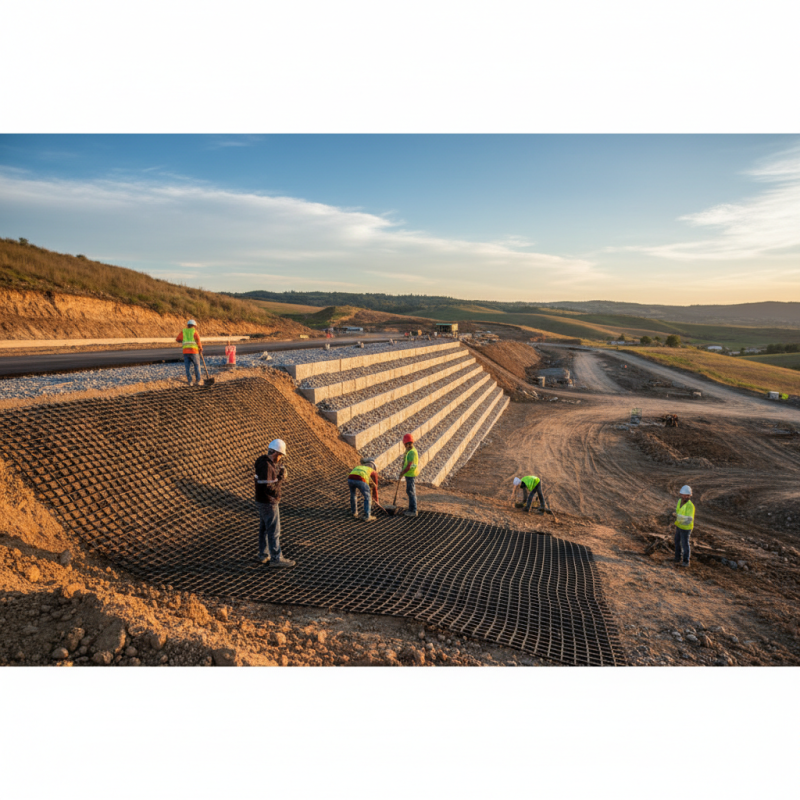
Soil Reinforcement Geogrids: Definition and Purpose Explained
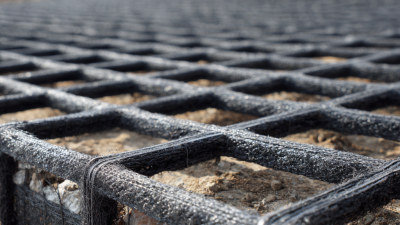
Soil reinforcement geogrids are crucial materials used in civil engineering and construction to improve the structural integrity of soil. These grid-like structures, often made from high-density polyethylene or polyester, act as a stabilizing agent, distributing loads and providing tensile strength to weak soil. By integrating geogrids into the ground, engineers can enhance the load-bearing capacity of the soil, making it suitable for heavy equipment and structures that might otherwise cause failure or excessive settling.
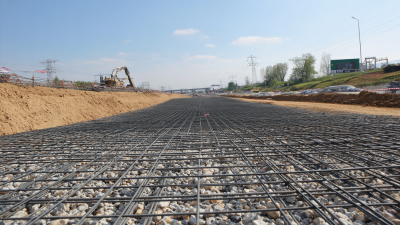
The primary purpose of soil reinforcement geogrids is to reduce soil deformation and increase overall stability. When laid in layers during the construction process, geogrids create a composite material that holds the soil particles together, preventing lateral movement and enhancing resistance to shear forces. This reinforcement is particularly beneficial in applications such as embankments, retaining walls, and paved surfaces, where soil stability is essential. The result is a more durable foundation that mitigates the risk of infrastructure damage and prolongs the lifespan of structures built on or within the treated soil.
Mechanisms of Soil Reinforcement with Geogrids in Construction
Soil reinforcement geogrids are an innovative solution in construction that significantly enhances the stability of structures built on varying soil conditions. The primary mechanism of soil reinforcement involves the geogrid's ability to interlock with the soil particles, creating a composite material that exhibits improved shear strength and load distribution. As loads are applied to the geogrid-reinforced soil, the grid helps to spread the stress over a larger area, minimizing the risk of localized failure. This mechanism is particularly beneficial for applications such as retaining walls, slopes, and foundations in areas prone to erosion or settlement.
In addition to interlocking, geogrids facilitate the development of tensile strength within the soil matrix. When a load is applied, the geogrid pulls on the surrounding soil, which helps to mobilize the soil's inherent strength and resistance to deformation. This not only enhances the overall performance of the soil but also enhances the durability of the construction. Furthermore, the installation of geogrids can lead to reduced construction time and costs, as they require less material than traditional reinforcement methods while providing substantial effectiveness in improving soil stability. The use of geogrids exemplifies how advanced materials can play a critical role in modern construction strategies, ensuring reliable and durable infrastructures.
2025 Guide: How Soil Reinforcement Geogrid Enhances Construction Stability
| Dimension |
Description |
Benefits |
Application Areas |
| Soil Types |
Clay, Sand, Gravel |
Improves load distribution |
Roadways, Embankments |
| Reinforcement Mechanisms |
Interlocking, tensioning |
Increases lateral restraint |
Slope stabilization, retaining walls |
| Durability |
Long-term performance |
Resistant to environmental degradation |
Highway projects, foundations |
| Cost-effectiveness |
Materials and installation |
Reduces overall project costs |
Commercial developments, infrastructure |
Types of Geogrids and Their Specific Applications in Stabilization
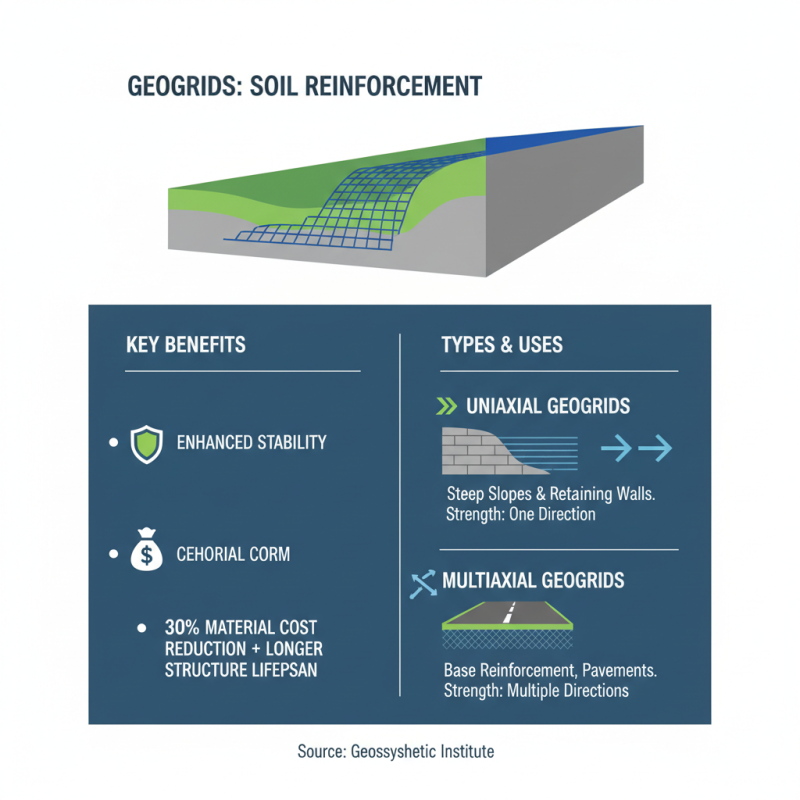
Geogrids are vital components in soil reinforcement, significantly enhancing construction stability across various applications. There are several types of geogrids, each designed to meet specific engineering requirements. For instance, uniaxial geogrids are predominantly employed in the construction of retaining walls and steep slopes due to their ability to provide exceptional tensile strength in one direction. These geogrids effectively distribute loads and enhance stability, making them essential for projects in challenging terrains. According to the Geosynthetic Institute, the use of geogrids in soil stabilization can lead to a 30% reduction in material costs while prolonging the lifespan of structures.
In contrast, biaxial geogrids are widely used in road and pavement applications. Their design allows for equal strength in both directions, which is crucial for managing the loads experienced by infrastructure under vehicular traffic. A report by the Federal Highway Administration indicates that projects that incorporate biaxial geogrids can exhibit a significant decrease in surface deformation, leading to lower maintenance costs and improved road performance. Fiber-reinforced composites have also emerged, showing promise in industrial applications, where they provide additional reinforcement to asphalt and concrete layers, optimizing the load-bearing capacity of pavements. These advancements in geogrid technology demonstrate their critical role in modern construction, enhancing stability, sustainability, and cost-effectiveness across various engineering projects.
Benefits of Using Geogrids for Long-term Structural Integrity
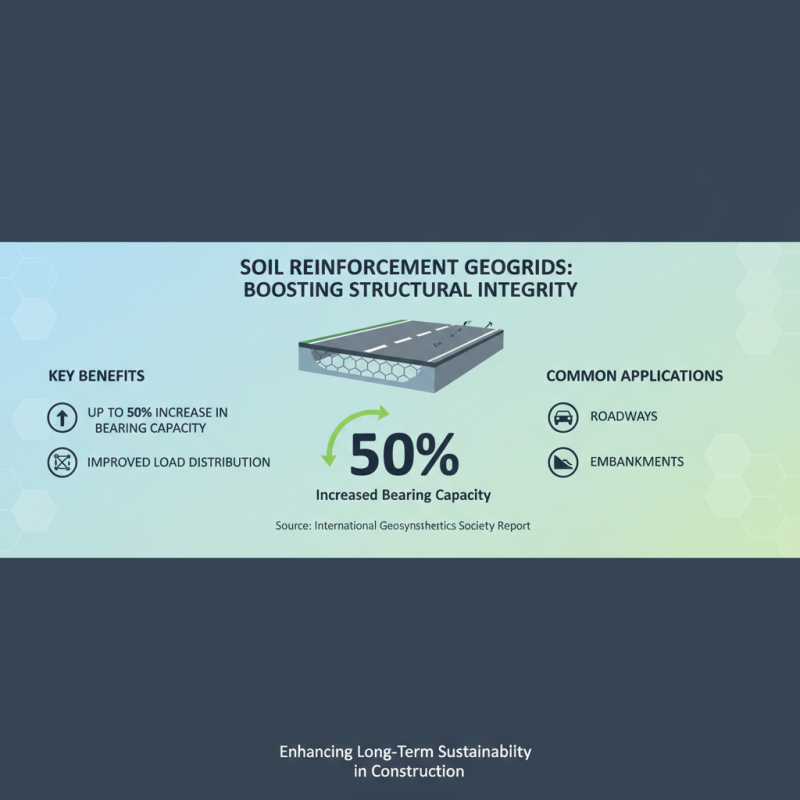
Soil reinforcement geogrids play a critical role in enhancing the long-term structural integrity of various construction projects. According to a report by the International Geosynthetics Society, the use of geogrids can lead to increases in bearing capacity by up to 50%, dramatically improving load distribution. This quality is especially beneficial in the construction of roadways and embankments, where soil erosion and settlement can compromise structural sustainability.
In addition to improved load distribution, geogrids significantly enhance soil stability through their ability to increase cohesion and reduce lateral movement. A study published in the Journal of Geotechnical and Geoenvironmental Engineering indicates that integrating geogrids into soil structures can decrease lateral earth pressures by approximately 30%. This effect not only prolongs the lifespan of structures but also minimizes maintenance costs, as stable soil conditions reduce the risk of damage over time. Moreover, geogrids often result in faster construction timelines because they allow for the use of marginal or low-quality soils, which can be reinforced rather than requiring extensive excavation or replacement.
As industry standards continue to evolve, the adoption of geogrid technology is increasingly recognized as an essential practice for ensuring long-term stability and sustainability in construction projects. Reports suggest that the market for geogrid applications is projected to grow significantly, driven by the demand for durable infrastructure solutions that can withstand changing environmental conditions.
Best Practices for Implementing Geogrids in Construction Projects
Soil reinforcement geogrids have emerged as a critical innovation in enhancing construction stability, particularly in challenging terrains. According to a report by the International Geosynthetics Society, the incorporation of geogrids can improve soil load-bearing capacity by up to 50%. These synthetic grid structures distribute loads over a larger area, minimizing differential settlement and enhancing overall ground stability. This capability makes geogrids especially valuable in areas prone to soil erosion or instability, ensuring that construction projects maintain integrity over time.
Implementing geogrids effectively requires adherence to best practices throughout the construction process. Detailed soil analysis is paramount, as understanding the specific characteristics of the soil will dictate the type of geogrid system necessary for optimal performance. The American Society of Civil Engineers recommends a layered approach; installing geogrids at multiple depths has shown to significantly reduce lateral earth pressures and improve the overall stiffness of the soil. Proper alignment and tensioning of the geogrids are also essential, as misalignment can lead to ineffective load distribution, potentially undermining the intended benefits. By adhering to these best practices, construction projects can leverage the full potential of geogrids, ensuring enhanced stability and longevity.